
Action isn’t narrative tension
But I can tell you what is.

This post is adapted from my editorsdesk.co blog. Read it here, read it there, I don’t care, read it anywhere.
We’ve all heard a lot of vague writing advice in our day. You know what I’m talking about. The kind of advice that isn’t actually advice, that’s just a platitude posing as advice.
“Raise the stakes.”
“Show, don’t tell.”
“Never use adverbs.”
(We are simply never going to yeet an entire part of speech in this blog. Not happening. Time may be a construct but you can’t tell it without adverbs.)
So, anyway, narrative tension.
You: The Writer. You can probably tell, intuitively, when your pacing is off. When your plot feels sluggish in parts. Maybe your beta readers lose interest and don’t finish the book. But when you ask for guidance you get more unhelpful advice and sound bites like:
“Just raise the stakes.”
“I didn’t feel dread—I wanted to feel dread.”
“You need faster pacing.”
(They might also hit you with the good old “Show, don’t tell!”)
Anyway, you already know you need to raise the stakes, create narrative tension, and speed the pace. That’s not advice you can use. That’s a diagnosis. Nobody is giving you a prescription.
Hello, it’s your good friend Catherine from Shelf Life and I have the prescription. I am not licensed to dispense pharmaceuticals. Do not let me take your blood pressure. I am not a real doctor. This isn’t Health Life.
So: You leave the conversation knowing something is wrong with your manuscript but having no idea how to fix it. And, worse, now you’re maybe a little embarrassed to ask again, because someone already told you “the answer” so confidently. Surely, you just don’t know how to interpret it. Surely, the problem is you.
The problem is not you. The problem is the person you went to for advice is just parroting what they were told when they asked the same question and they don’t want to be the first guy in this long chain of guys to point out that, you know, maybe I’m crazy, but, it kind of seems like the emperor has no clothes?
“Just raise the stakes” is the (second) emptiest plate in the buffet of writing advice (after “show, don’t tell”).
I know because I’ve been an editor for more than 20 years. I’ve watched smart, talented writers spin their wheels on this exact problem.
The mistake many of us make
When a manuscript feels slow, most of us reach for the same lever: action. Add a chase scene. A fight. An explosion. Surely more stuff happening means faster pace, right?
Wrong. Action without tension is just motion. Imagine a pizza delivery guy. He’s zooming from place to place to place on his motorbike (or his beat up 2006 Honda Civic, who am I to judge?). He’s delivering pizzas. He hands off a pizza every six-and-a-half-minutes. Things are happening rapid fire but there’s no tension.
I’ve seen writers actively damage their manuscripts by adding action set pieces to try and speed the pace. Scenes that should have been tense but landed flat because the reader didn’t actually care about the outcome. Action as filler is worse than no action at all.
So if action isn’t tension, what is?
Tension is the gap between what the reader knows and what the reader wants
That’s it. Not action. Not conflict. Not even suspense (which is tension with a ticking clock).
Tension is uncertainty. It’s the reader leaning forward, not knowing whether or when or how the outcome they want will happen.
Unless you’ve written a novel in which the narrator is clairvoyant and the reader knows everything at all times, then every scene in your manuscript has tension. Either you put it there on purpose, or it’s there by accident. Either it’s working for you, or it’s working against you.
(I take that back: You could still have narrative tension even if the reader knows everything at all times. When the reader knows important information that the protagonist doesn’t have yet? Tension goldmine.)
Action without tension? That’s the pizza deliverator metaphor from above.
Tension without action? Totally possible. Imagine a romance novel. Will they kiss or won’t they? Maybe they’re just sitting on the sofa watching Netflix. Nobody is moving. No action is happening whatsoever. But the tension is crackling because the reader doesn’t know if their desired outcome (the kiss) is coming or not.
What I built (and why)
When I edit, I map tension in my head. I do it without thinking after 20 years of doing this. A graph of peaks and valleys, ranges and averages. When I tell an author, “this chapter is slow when it should be fast,” I’m not basing this feedback on vibes. I know when a middle sags or when a climax arrives too early or when a reader is going to put the book down and never pick it up again.
I’ve only recently figured out how to teach that intuition.
So I sat down and built the thing I wished for because it didn’t exist: a repeatable, concrete system for measuring and mapping narrative tension.
I call it The Tension Architect.

It’s a workbook that walks you through:
A 1–10 tension rubric (no vibes, no guesswork)
A scene-by-scene inventory of your manuscript
A tension graph that reveals the shape of your narrative
Named problem patterns (the Flatline, the Sawtooth, the False Summit, and more)
A diagnostic and revision plan that tells you exactly what to fix
No more “the pacing feels off but I don’t know why.” No more adding explosions and hoping for the best.
You graph the problem so you can see its shape. Physically, with your eyeballs. Then you fix it.
The fishing pole
Here’s how I think about narrative tension.
Your premise is the bait.
Your conflict is the hook.
The reader bites.
Then what? You don’t just let them sit there. You reel them in.
That’s what narrative tension does. It’s the fishing line connecting your hook to your hand. It’s the tool you use to pull your reader through your novel. Every scene either pulls the line tighter or lets it go slack.
The Tension Architect shows you exactly where your line is tight, where it’s loose, and where the fish might give up on your bait, however juicy and worm-y, and swim away entirely.
A quick example: The Shining
Stephen King’s The Shining is a masterclass in tension architecture.
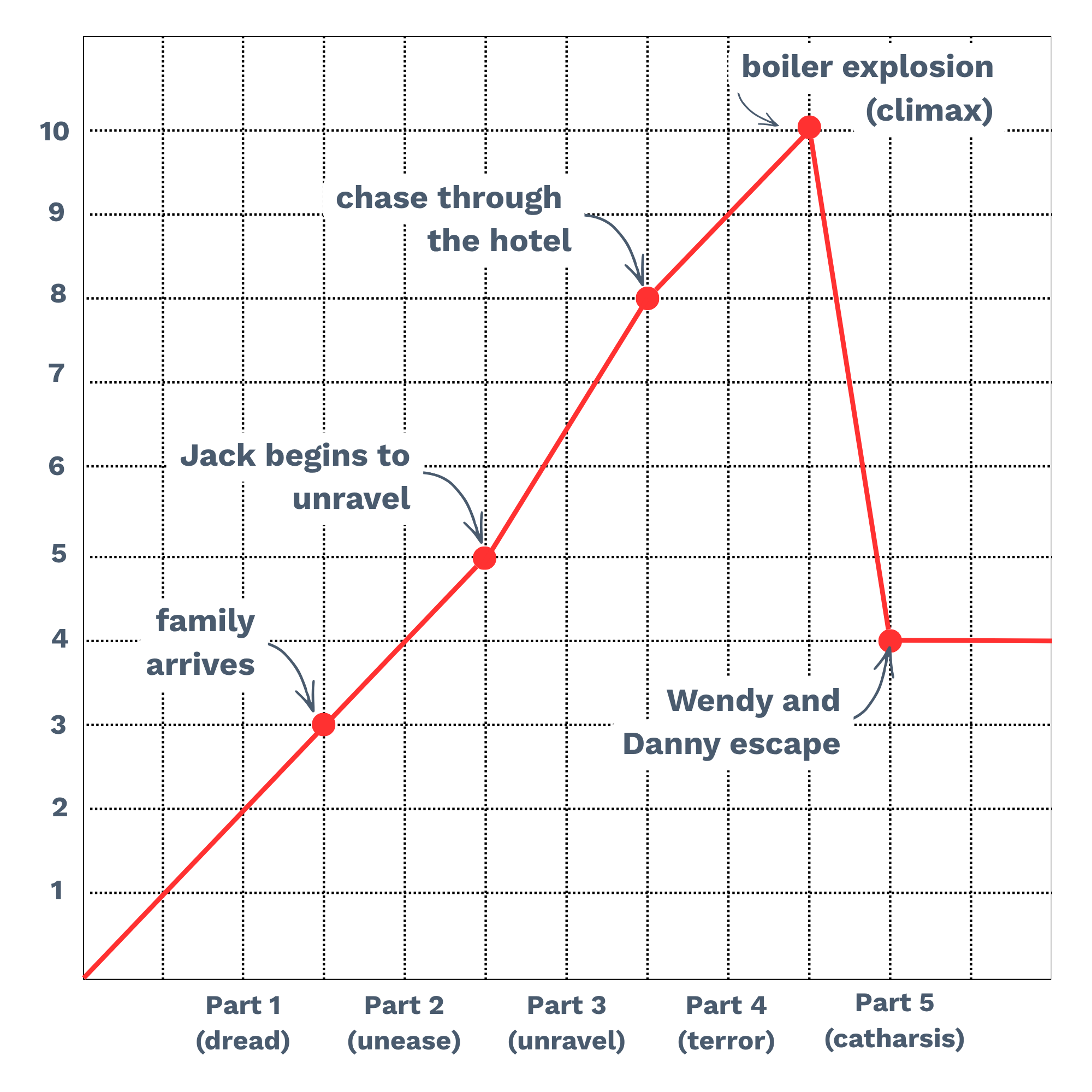
Nothing supernatural happens for the first hundred pages. No hedge animals attacking. No roque mallet swinging. Just a family, an isolated hotel, and a slow, inexorable unraveling. But you feel it tightening like a blood pressure cuff around your arm.
Why?
Because King introduces threats long before they activate. The mallet appears early. The hedge animals are mentioned. The Overlook’s history is laid out. The reader knows something crucial that Jack doesn’t (tension goldmine, remember?).
Because that’s Chekhov’s roque mallet.
That gap—between what you know (that the Overlook is going to do something terrible to this family) and what you want (for the family to make it out safely and together)—is the tension. And it climbs. And climbs. And climbs.
That’s what “raise the stakes” actually looks like when someone shows you how.
One more thing (and why I’m telling you this)
The Tension Architect is a mini-workbook. It complements my system, The Editor’s Pass, which launches May 25.
If you buy this deep dive and later decide you want to upgrade to the complete system, I’ll discount the full price by exactly what you paid for this one. It has a coupon code on the last page.
Not because I’m generous (well, maybe a little). But because I think it’s fair. I don’t want you to feel like you wasted money if you upgrade. That’s it. That’s the whole reason. I have a whole thing about ethical business practices.
You can print this PDF once, twice, as many times as you need. You can use it with every manuscript, every revision. Mark it up all you want. You never have to buy it again.
The only question that matters
After reading this, I don’t need you to buy anything. I need you to ask yourself one question:
If I could see the shape of my manuscript’s tension—every peak, every valley, every flatline—would that help me?
If the answer is yes, you know where to find me.
If the answer is no, that’s okay too. But watch this space. Because I’ve got a lot of tools coming for the problems you do have.
Can’t wait for The Editor’s Pass, or you think The Tension Architect might be too in-depth for what you need right now? Sign up for updates at editorsdesk.co and receive a free worksheet to diagnose your manuscript’s structural problems in 5 minutes or less.
(PS—if you already subscribe to Shelf Life, just plug in the same email address to get the worksheet. It’s all one list. You won’t get duplicate emails.)
I’m trying to find the right balance between giving you information in this Substack, for free, that you can truly use, and also offering you my paid content like The Tension Architect. If I’m getting it wrong, I hope you’ll reach out and let me know.
As always, I’m glad you’re here. Thank you for reading.
If you have questions that you’d like to see answered in Shelf Life, ideas for topics that you’d like to explore, or feedback on the newsletter, please feel free to contact me. I would love to hear from you.
For more information about who I am, what I do, and, most important, what my dog looks like, please visit my website.
After you have read a few posts, if you find that you’re enjoying Shelf Life, please recommend it to your word-oriented friends.