
A Goal Without a Plan(ner)
The planner I built for writers because I couldn't find one that worked for me

Welcome to Shelf Life where we are planning to succeed—because when you fail to plan you plan to fail (Benjamin Franklin, famous Goodnotes user).
First: Editing for Writers is available for presale now on Kindle. If you preorder, it will be delivered to your Kindle on its July 27 release date. A paperback edition will also be available on July 27, but isn’t yet available for presale.

Should you buy this? No! It’s a curated collection of twenty-four essays that you can read for free in Shelf Life, but edited into a collection. However, if you want to add Shelf Life to your book shelf, or you like paying for stuff you can get for free, or whatever, it’s available. I’m just letting you know. Letting you know things is the whole reason Shelf Life exists.
Now: A confession. I’m obsessed with planners and planning. You may already know this if you’ve read previous Shelf Life articles like Getting Started With Bullet Journaling or Little Habit Tracker That Could.
Anyway: Bullet journals. Trackers. Logs. Anything that promises to turn the chaos in my brain into tidy little boxes I can check off. I absolutely love checking something off a list. Very few things produce that kind of dopamine for me.
I was diagnosed with ADHD in my mid-thirties, but I’d been building my own coping systems for decades before that. Some worked. Some didn’t. All of them taught me something about how my brain needs to see information in order to process it.
So when I dug the first draft of my novel out of the trunk and decided to make a real effort at revising it, realized I had no idea how.
I mean, I know how to revise. I know what to do. I’m an editor, after all. Revising novels is kind of my whole thing. It wasn’t the mechanics of revising that was my problem. It was staying organized. Keeping track of what I’d done and what was left to do. Organizing all the information of the revision in one place instead of 50 sticky notes, two half-filled bullet journals, a composition notebook, and 12 scattered Word documents.
That’s what the inside of an ADHD brain looks like all the time, by the way. Like Munch’s The Scream, basically.
So, in short, the tool I needed didn’t exist. (This is a recurring theme for me.)
I needed something that tracked plot holes and scene-level pacing and character consistency and line-level polish. I needed something that combined all the logs and trackers I needed for revision and also provided the daily, weekly, and monthly planning pages that would keep me on track, not for my life generally, but for my revision process.
I’ve been thinking of it as “the season of revision” but that’s a little too, I don’t know, live-laugh-love for my comfort.
I sat down and asked myself: What do I really need here?
A planner
For my trusty Goodnotes app
That’s fully linked so I don’t have to swipe forever to find what I need
If you’re drafting or planning your novel? There are tons of these. Etsy is loaded with them. Revising? Not so much.
So I built it.
It’s called the Revision Planner for Writers. It’s a digital planner for Goodnotes and Notability. Fully hyperlinked. Undated. 67 collection pages across 7 sections: Setup, Structure, Character, Scene, Polish, Beta, and Final Pass.
I’ve been using it to revise my own novel, and I have to say: it’s the first time I’ve felt like I have a true bird’s eye view of what I’m doing and where I’m going. Not because it does the work for me—it doesn’t—but because it gives me a place to put everything I find. A structure. A map.
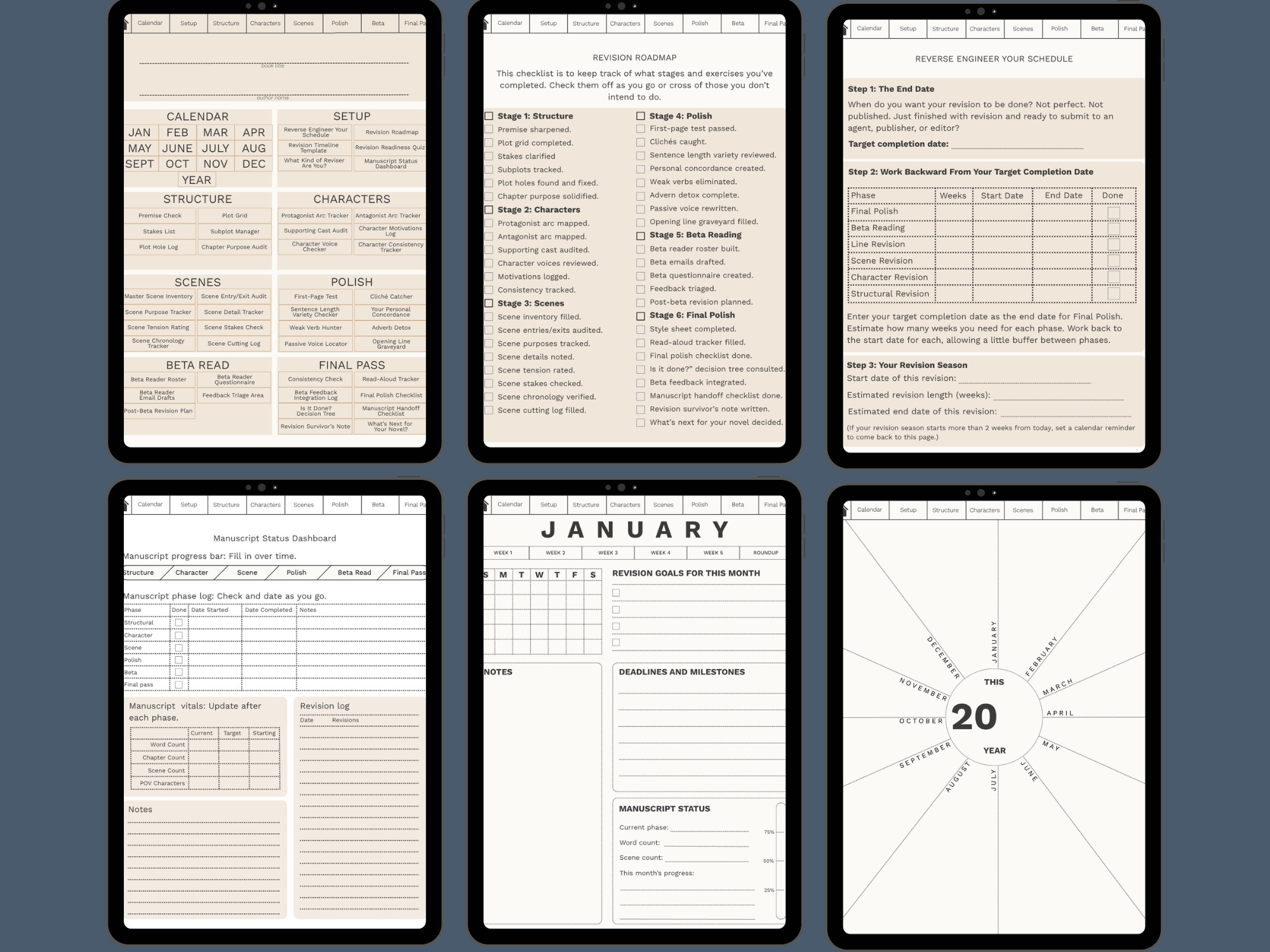
I’m not going to tell you to buy it. That’s not what Shelf Life is about. Instead, I’m going to walk you through it and show you some of the most valuable things inside so that you can get the value without buying it.
Shelf Life is not a sales pitch. Shelf Life is about me providing free value to you. So let’s do it. I’m going to walk you through a few pages from the planner and how they work. Then, at the end of this article, I’m going to share a link for a free mini-version of the planner that has the full setup section for you so you can give it a try.
Sound good?
Reverse Engineer Your Schedule
I can’t speak for anybody else, but if I don’t set deadlines I don’t get anything done. “Whenever you get a chance” means: “Right this moment or literally never.”
So the first thing I realized I needed was a schedule to stick to. A lot of being a production editor is project management. I have a lot of experience working backward from a publication date to find the date we absolutely, positively, drop-dead have to have that manuscript in production.
So, I apply the same philosophy with this page. Let’s say you have a deadline to complete your revision. Maybe it’s arbitrary. Maybe it’s based on something—maybe your agent is waiting for it, maybe you want to finish before your birthday, maybe you already have a pub date in mind and this revision is just one part of the work. So you start with your target completion date.
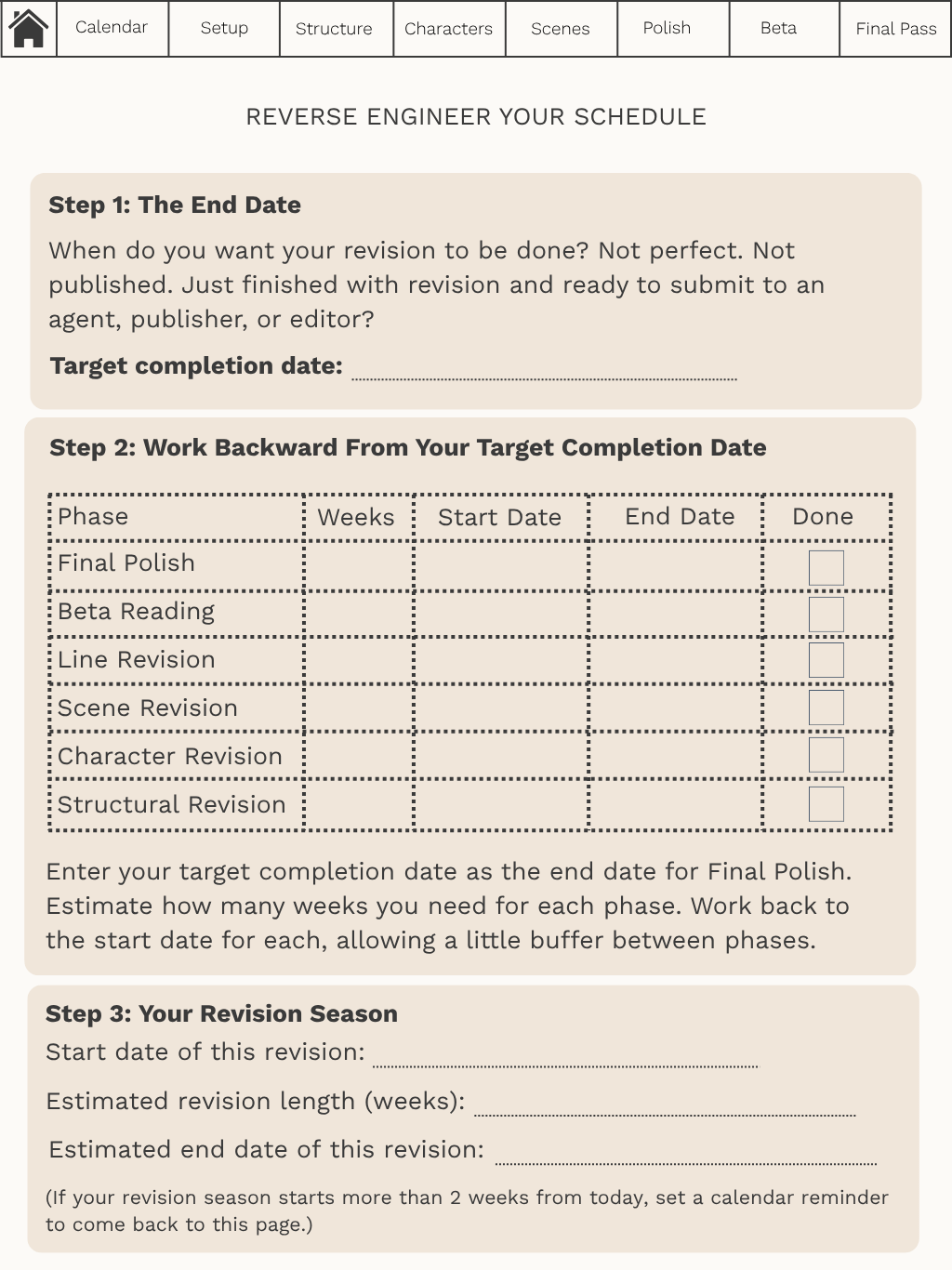
Next, you’ll estimate how many weeks you need for each phase. How much time do you want to spend on the structural revision? How much time do you want to allot for beta reading? And so on. Your next step is filling in the “weeks” column.
Then, you work backward from your target completion date:
Does working backward bring you to a start date of today? Brilliant.
Does working backward bring you to a start date that’s in the past? Then you need to either adjust your end date or tighten up somewhere.
Does working backward bring you to a start date in the future? Then you can give yourself more time somewhere.
Once this high-level schedule is filled out, you can use the year at a glance to note when you’ll be handling which phases, and add reminders to the specific month and week pages where you’re planning to start various phases.
The Protagonist Arc Tracker
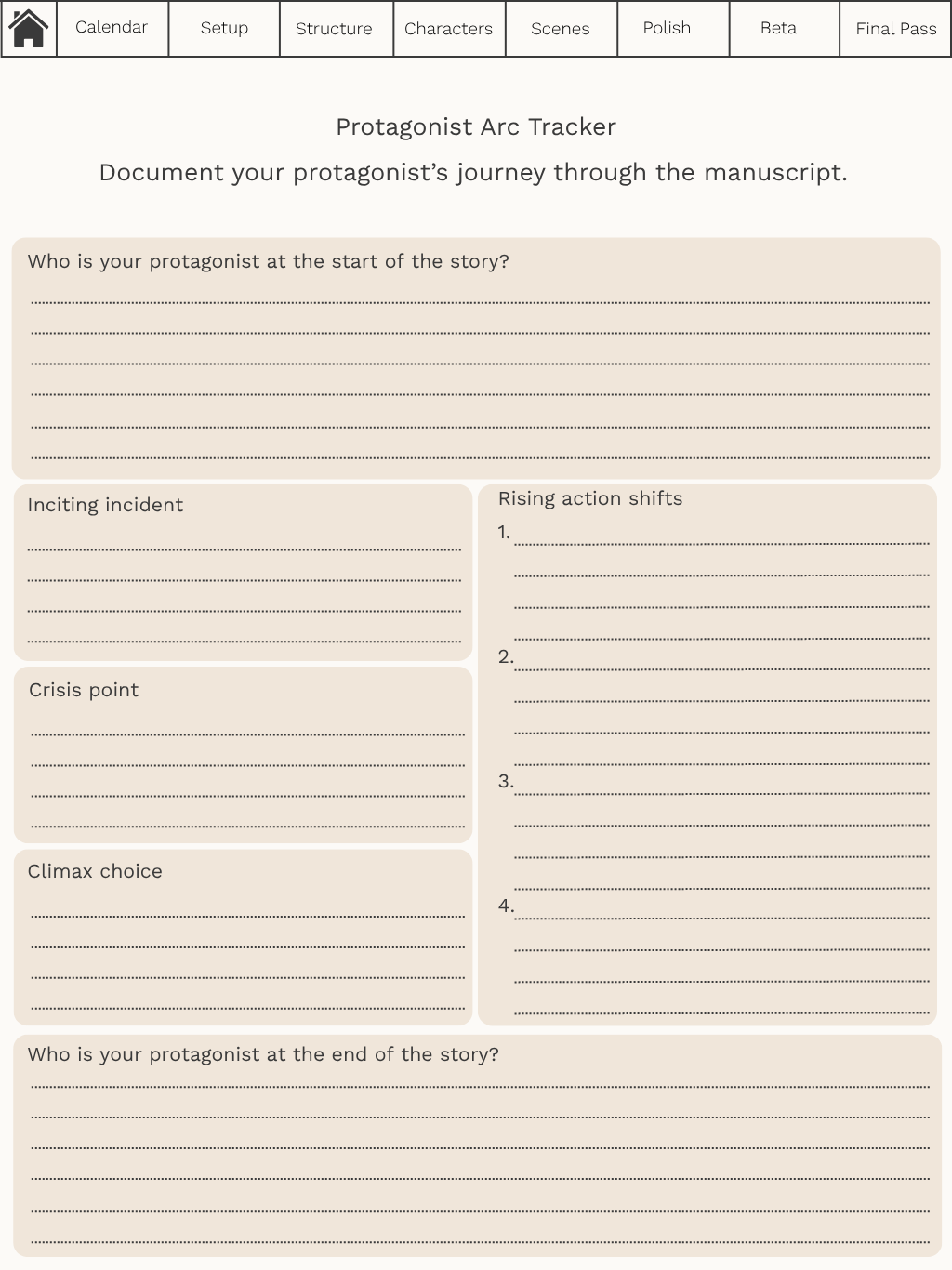
The protagonist arc tracker is a space to document your hero’s journey through the story.
One of the main structural issues that sinks manuscripts is a passive or static protagonist. (You can grab a free guide to the other big structural bugaboos here.)
Authors are attached to our protagonists. They’re basically a roommate that lives inside your head, sharing space in your brain, maybe for the rest of your life (TBD). It’s not always easy to look at our main character and diagnose the flaws in their arc. This tracker makes you examine exactly how your character grows and changes throughout the story. If you can’t do that—if you can’t show a meaningful change from the first box to the last, if you can’t articulate the choices your character makes that change the direction of the plot, then you have a flat character who’s going to sink your book.
This page does double duty. You can write down what’s actually in your first draft, and then you can duplicate the page and write down what should happen for this character, how they should grow and change, if they don’t actually do that in your draft.
The Month at a Glance
Why aren’t the dates filled out, Catherine? Because I want you to be able to use this planner forever. I don’t want to sell a new one every year (because I hate money, I guess). The blank calendar grid lets you fill in the dates for January, whether it’s January 2027, 2028, 2042, 2099—this planner is good forever.
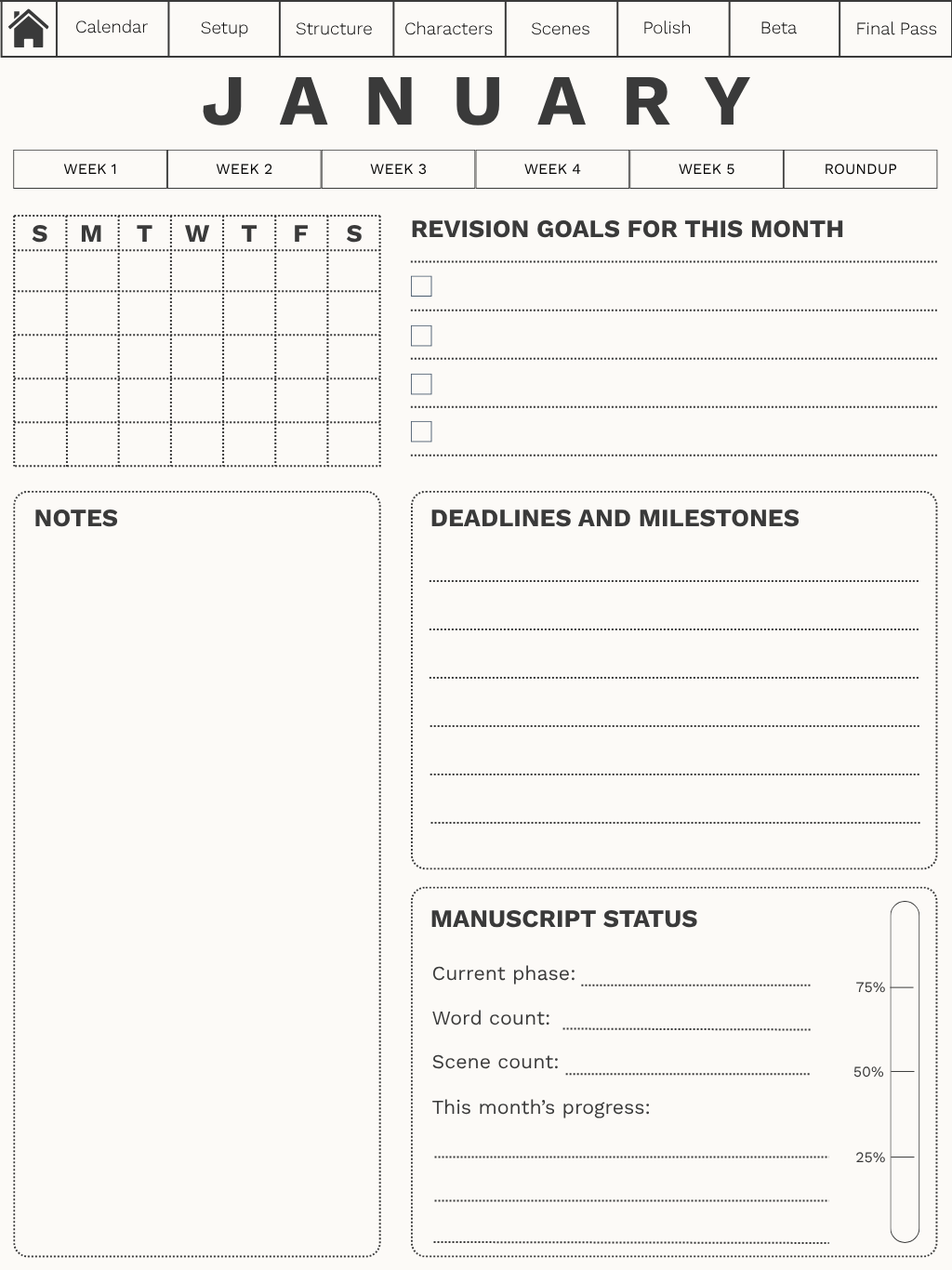
This is a monthly page like you’ll see in a lot of planners, but with a twist. It’s not geared toward your month generally. It’s specifically about your month in revision.
Fill in the calendar grid (or ignore it, I’m not your boss, do what you want).
Add your revision goals for the month based on what you determined in the reverse-engineered schedule.
Write down the milestones you want to achieve this month.
Fill in your manuscript’s current status and color in the bar—how far are you at the beginning of January? Use one color. At the end of January, come back with a different color and fill the bar some more so you can visualize your progress.
Note that the month page links to each of five weeks (each week, in turn, has seven days). There’s also a roundup page for each month, something I migrated over from my hand-drawn bullet journals:
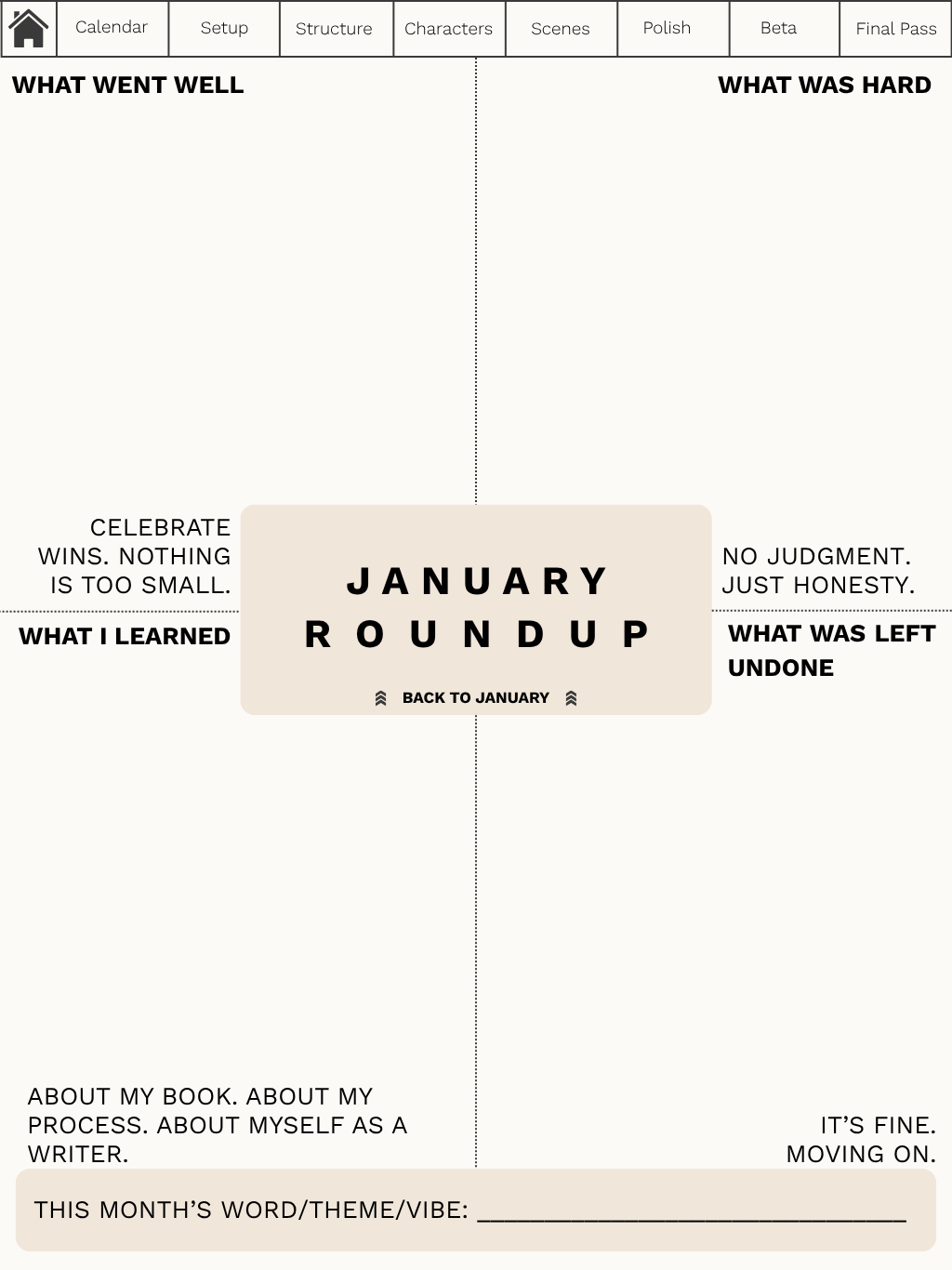
The roundup is a page to capture the month in review. You’ll look back at these later and see how you’ve grown and changed, what you’ve accomplished, and (perhaps most important) what you’ve let go.
Download Your Free Mini-Planner Now
No catch. No signup (although I’d love it if you did). Just click to download your free mini-planner. The zip file contains the mini-planner, which includes the cover; index; year at a glance; sample month, week, and day; and the complete setup section, including:
Reverse engineer your revision schedule
The revision roadmap
The revision timeline template
The revision readiness quiz
“What kind of reviser are you” quiz?
The manuscript status dashboard
The zip file also contains a PDF on how to use the planner, including importing it into Goodnotes or Notability and duplicating pages.
Click here to download your free mini-planner. If you enjoy it, let me know in the comments!
If you like it and want to upgrade to the full planner, it’s available in my shop.
If you have questions that you’d like to see answered in Shelf Life, ideas for topics that you’d like to explore, or feedback on the newsletter, please feel free to contact me. I would love to hear from you.
For more information about who I am, what I do, and, most important, what my dog looks like, please visit my website.
After you have read a few posts, if you find that you’re enjoying Shelf Life, please recommend it to your word-oriented friends.